
New Psychosocial Hazards: Understanding the Root Cause and Fixing It!
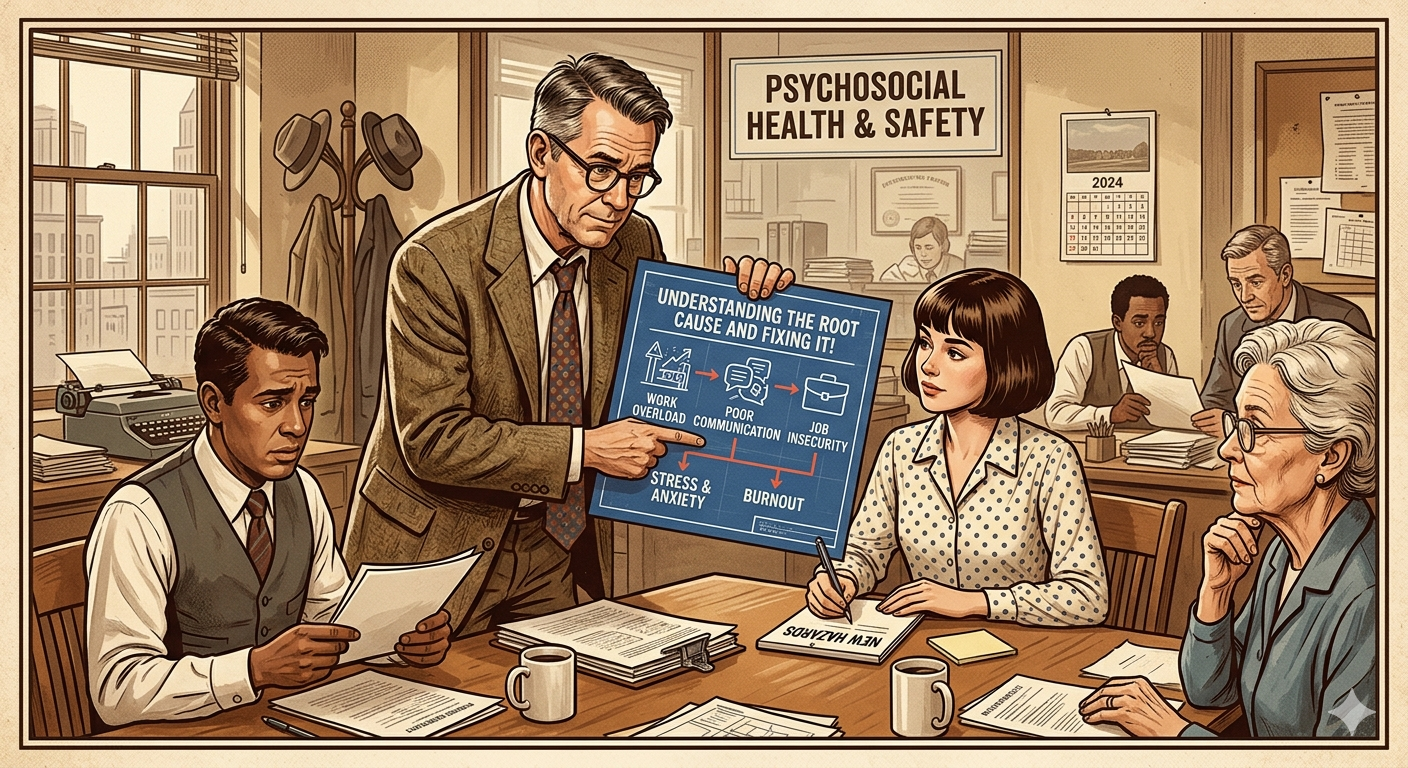
Controlling Psychosocial Hazards
For over forty years, the global safety community has been chasing a ghost. We’ve perfected the "hard" side of safety—guarding machines and wearing high-visibility vests—yet workers are still getting hurt at alarming rates. The data is finally in, and it is definitive: A "toxic" work culture isn't just an HR headache; it is a primary hazard that manifests in cognitive failure, physical injury, and death.
The shift toward proactive enforcement is the result of four decades of harrowing data collection. While "work stress" was once considered a personal issue, the 1984 Joint ILO/WHO Committee on Occupational Health formally defined psychosocial factors as the interaction between the work environment and a worker’s culture and capacity.
This sparked many years of longitudinal studies correlating insurance claims, mobility data, and mortality stats. Researchers found that "toxic" indicators—high demand coupled with low control—physically degrade the human brain. Chronic stress leads to cognitive tunnelling, where a worker’s brain loses the ability to scan for hazards. Whether you are a nurse in a high-pressure ward or a sawyer in a BC mill, a toxic culture effectively "blinds" you to the risks in front of you.
We no longer have to look back a century to see how culture kills; modern industrial disasters provide a clear roadmap of psychosocial neglect. Here are two of too many to be mentioned:
• Deepwater Horizon (2010): While a mechanical "blowout" was the physical event, the US Chemical Safety Board identified a culture that prioritised "speed over safety" due to massive budget overruns. Workers felt unable to exercise their Right to Participate or report pressure anomalies because the culture punished "bad news."
• Dreamworld Thunder River Rapids (2016): An Australian coroner found a "frighteningly unsophisticated" safety culture. Management failed to conduct holistic risk assessments for 30 years, creating a culture where small deviations became "normal" until four people lost their lives.
In the Healthcare, Education, and Care industries, this manifests as a "culture of sacrifice." When a care aide is pressured to perform a heavy lift without a partner because a facility is "short-staffed," or a teacher is told to ignore workplace violence to "keep the peace," the culture is inducing a hazard. This "Normalisation of Deviance" is exactly why psychosocial triggers are now prosecutable
In 2013, Canada led the world with CAN/CSA-Z1003-13, the National Standard for Psychological Health and Safety. This was followed in 2021 by ISO 45003. These aren't just lists of "soft skills"; they are the 13 foundational pillars of a safe workplace.
To mitigate these hazards, an organisation must address specific factors such as Workload Management (ensuring tasks fit the time available), Psychological Protection (allowing workers to report errors without fear), and Involvement & Influence (giving workers a seat at the table). These factors act as the "guardrails" that prevent a culture from sliding into toxicity.
Proving Compliance: Moving Beyond the "Vibe"
For Small and Medium-Sized Businesses (SMEs) in British Columbia, the "we’re like a family" defense no longer holds water with WorkSafeBC. Mitigation must be evidenced through a clear "Paper Trail of Care." Proving you have a healthy culture requires three levels of documentation:
1. The Policy Level: A formal Psychological Health and Safety Policy and job descriptions that reflect Clear Leadership and Expectations.
2. The Procedural Level: Active Psychosocial Risk Assessments and a Near-Miss Log specifically for mental health triggers, proving the organisation investigates "close calls" like bullying or burnout.
3. The Evidence Level: Anonymised Safety Climate Surveys and Joint Health and Safety Committee minutes that prove workers are utilising their Right to Participate.
WorkSafeBC is moving to proactive enforcement (I encourage you to visit their website: https://www.worksafebc.com/en/health-safety/create-manage/managing-psychological-health-safety
because the data shows that by the time blood is spilt, the psychosocial hazards have been present for years. For an SME, one major psychosocial claim or a culture-driven "Serious Injury" can be financially devastating.
We have the tools. We have the data. The only thing left is the courage to admit that how we treat our people is our most important safety protocol. By documenting the 13 factors and opening a genuine dialogue through near-miss reporting, we stop chasing ghosts and start saving lives.
Sources:
• Joint ILO/WHO Committee on Occupational Health (1984): Ninth Session Report.
• CSA Z1003-13 (R2022): Psychological health and safety in the workplace.
• ISO 45003:2021: Occupational health and safety management — Psychological health and safety at work.
• WorkSafeBC Statistics: Mental Health Disorder Claims Trends 2020-2025.
• U.S. Chemical Safety Board (CSB) Investigation Report: Macondo Blowout and Explosion.
